Classical Buddhist Language Programs For Scholars and Dharma Students
MRC’s online language courses support deeper engagement with Buddhist literature and philosophy. First year courses in Sanskrit and Tibetan provide a foundation in native linguistic theory, grammar, and vocabulary with chanting and reading of simple Buddhist texts. Second year reading courses provide an opportunity to consolidate this knowledge while reading a variety of genres. Translation Workshops and advanced reading seminars serve scholars interested in refining and developing their understanding of texts in Classical Buddhist languages.
Upcoming Event
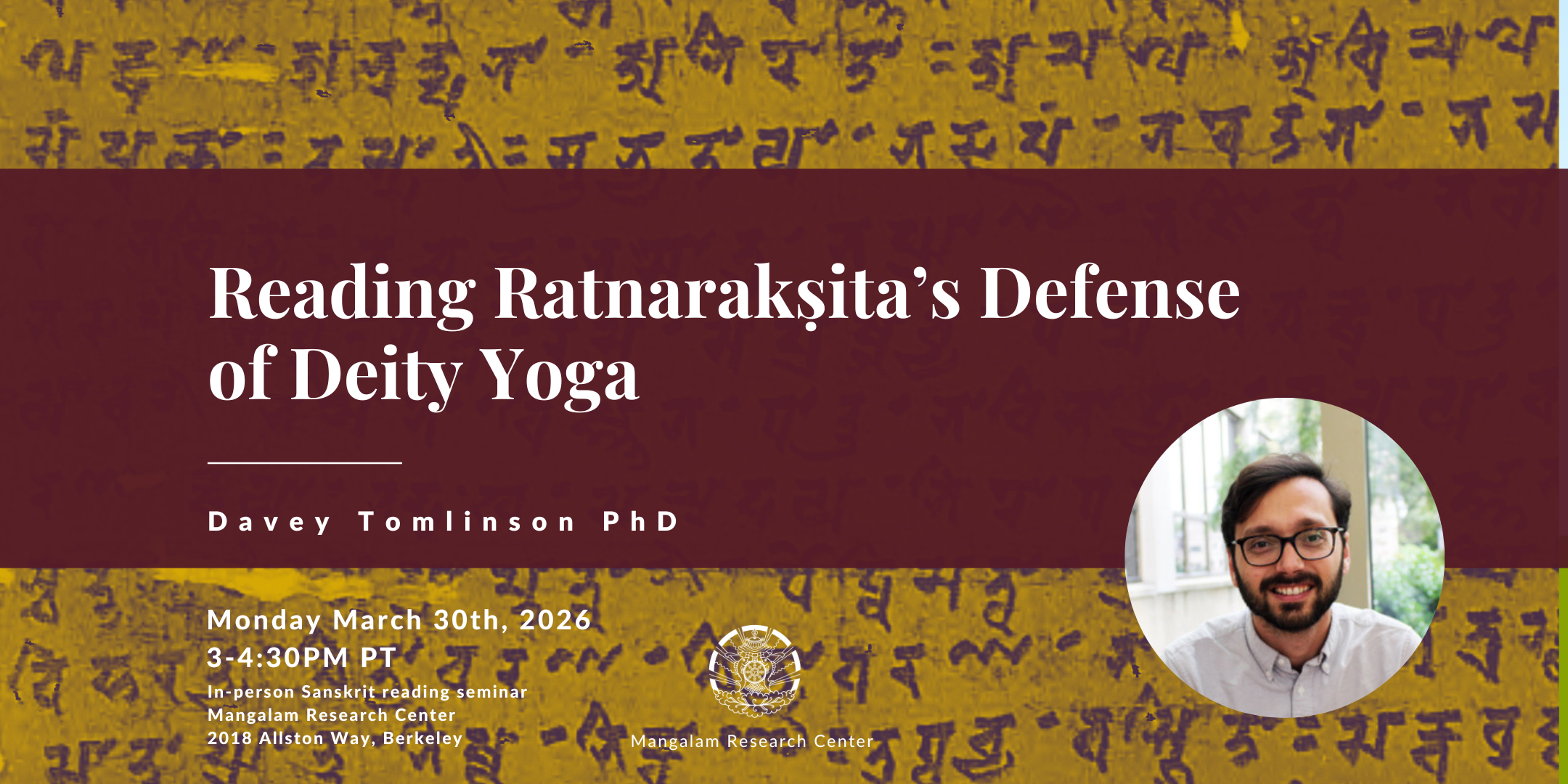
Reading Ratnarakṣita’s Defense of Deity Yoga
Date: Mon, Mar 30
Time 3-4:30 pm PT
This Sanskrit reading seminar will be held in-person at Mangalam Research Center for Buddhist Languages, 2018 Allston Way, Berkeley, CA 94704.
Note: The Sanskrit text {and English translation} will be distributed in advance to those who are interested. Please write to julie@mangalamcenter.org to request a copy of the text.
How does deity yoga (devatāyoga) work? Why is the generation stage (utpattikrama) an essential part of the tantric path? In this Sanskrit reading seminar, we’ll read portions of Ratnarakṣita’s excursus on these topics in his commentary on the Saṃvarodayatantra, where he first lays out objections to generation-stage practice and then defends its efficacy and fundamental importance. Note: The Sanskrit text {and English translation} will be distributed in advance to those who are interested. Please write to julie@mangalamcenter.org to request a copy of the text.
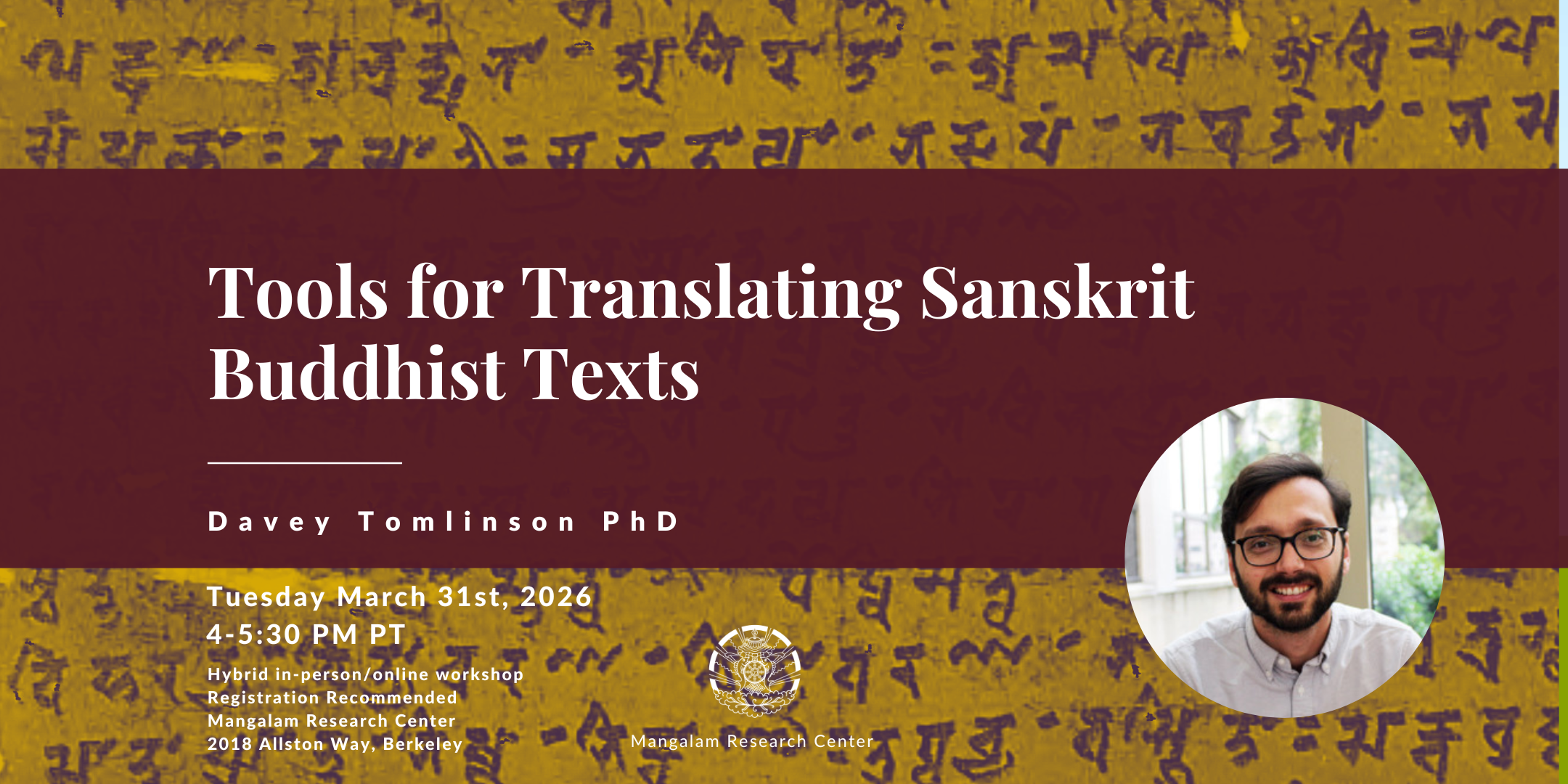
Tools for Translating Sanskrit Buddhist Texts
Davey Tomlinson, PhD
Date: Tue Mar 31, 2026
Time: 4-5:30 pm PT
This hybrid talk will be held both in-person at Mangalam Research Center for Buddhist Languages, 2018 Allston Way, Berkeley, CA 94704, and online on Zoom.
There has been an exciting proliferation of online resources for research on Sanskrit Buddhist texts in recent years, but it can be hard to know where to start. This workshop will offer practical guidance to some of what’s available online—archives of manuscripts and editions, dictionaries, encyclopedias, grammars, websites, and AI tools—as well as tips and tricks to use offline. We’ll also talk about audience, annotations, norms around brackets in translations, and other topics important to translators. The workshop’s aim is to help give students, translators, and scholars relatively new to the study of Buddhism in Sanskrit the means to advance their training and to help them evaluate the merits of the many resources out there. Along the way, we will walk through some specific cases to see how these tools work in practice.
Davey K. Tomlinson is Assistant Professor of Philosophy at Villanova University. His research is centered on late Indian Buddhist philosophy, focusing on epistemology and philosophy of mind in Dharmakīrti and his followers, Buddhist tantra, and debates about buddhahood and transformative experience. He is currently completing a monograph, What Is It Like To Be A Buddha? Indian Buddhist Philosophy After the Tantric Turn, as well as a book in collaboration with Nilanjan Das and Catherine Prueitt, Prajñākaragupta On What Exists.
Past Event
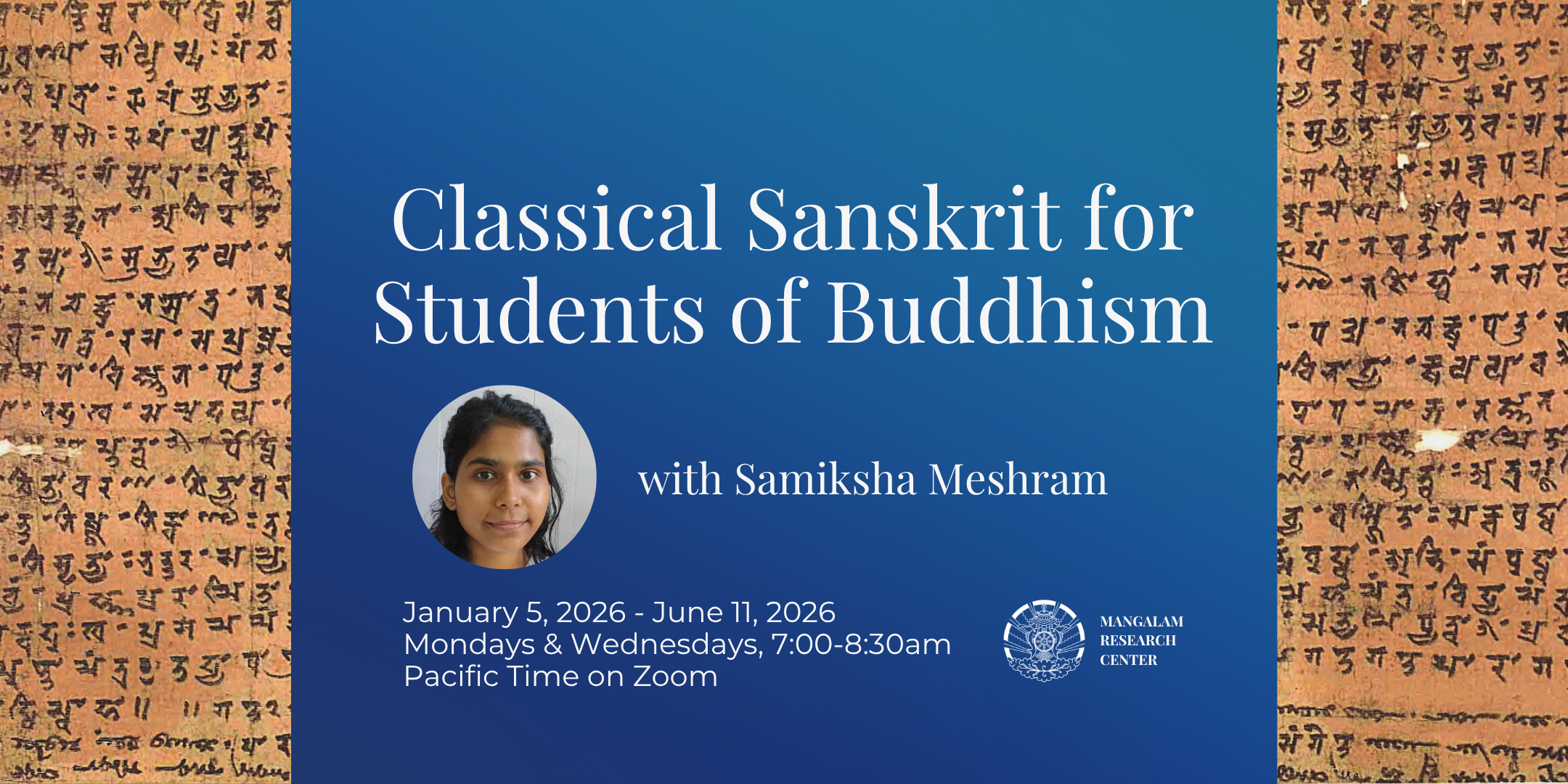
Classical Sanskrit for Students of Buddhism
Mondays & Wednesdays
January 5, 2026 - June 10, 2026*
7-8:30am Pacific (on Zoom)
This course is designed to support deeper engagement with Buddhist texts and literature in Sanskrit. Over 48 classes, students will gain a solid foundation in Sanskrit grammar and begin reading simple Buddhist texts. Students who complete the course successfully will have the skills to join a second year university course. Please note that class enrollment is limited to 16 students to ensure individual attention and time for questions.
*A couple of make-up/additional classes will be offered at a time that works for most students to accommodate the full curriculum.
What is different about this Sanskrit course? This course differs from most introductory Sanskrit courses in that it: 1) emphasizes gradual assimilation of grammar through recitation; 2) draws vocabulary and grammatical examples primarily from Buddhist texts (such the Heart Sūtra and Dharmasaṅgraha) and stories (such as jātakas); and 3) provides an introduction to native Sanskrit grammatical concepts (instead of concepts from Latin/Greek), which are essential for the deeper study of Buddhist texts and commentaries.
The course materials (textbook and video recordings for the recitation) have been developed by Professor Dr. Mattia Salvini (International Buddhist College, Thailand).
Structure of the course: Class sessions will be devoted to the introduction of new grammatical structures, review of homework, and group recitation. Weekly homework will consist of recitation (15-30 minutes per day) and short written assignments (about 3-4 hours per week).
Who is this class for?: This class is designed for students interested in deeper engagement with Buddhism through the study of primary sources in Sanskrit. While there are no grades or exams, diligence in recitation and written homework and attending live class sessions [3 hours per week] is critical for successful completion of the course. However, recordings of the class will be made available in case a student needs to miss a session or would like to review it.
Tuition for the course is $900. Payment plans and a limited number scholarships are available. Enroll today with the button below, or, if you have any questions about tuition, payment, or scholarships please write programs@mangalamresearch.org. Any questions about the course schedule and content should be directed to Instructor Samiksha Meshram (samikshameshram296@gmail.com)
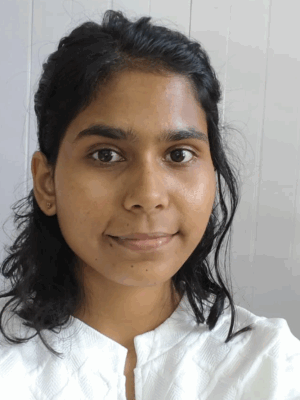
About the instructor: Samiksha Meshram received a B.A. in Buddhist Studies and Ambedkar Thought from Nagpur University, India. She received her M.A. in Buddhist Studies from International Buddhist College (IBC), Thailand, where she is currently pursuing her Ph.D. in Buddhist Studies. Her doctoral research focuses on the ninth chapter of Yaśomitra’s Sputārthā Abhidharmakośavyākhyā, a Sanskrit sub-commentary on Vasubandhu’s Abhidharmakośabhāṣya, which she is translating into English. Her interests include Buddhist philosophy, Abhidharma traditions, and Indian philosophical systems. She enjoys studying and teaching Sanskrit and Buddhist philosophical and Abhidharmic texts.
She has taught Mahāyāna Buddhism at the undergraduate level at IBC, has been teaching an intermediate summer Sanskrit course at Ranjung Yeshe Institute (RYI) in Nepal, and continues to teach Sanskrit online. She has also taught Sanskrit and delivered lectures on Buddhism in various parts of Malaysia.
Donate to our Scholarship Program
Help Dharma students learn the language skills to read Dharma texts in their original language.
Our wish is to offer Classical Tibetan and Sanskrit language instruction to anyone with the desire and commitment to learn, regardless of their financial circumstances. Help us keep our courses accessible by donating to offset the costs of offering such programs free of charge to the participants.