
How to Live in Hard Times: Examples from Buddhist Lives
The talks in this series respond to our need for inspiration in this moment, as scholars and as human beings. Each scholar has identified an historical figure who lived in times of personal and political upheaval, not unlike our own. Drawing on the writings of these figures, they highlight the value of literary works in provoking insight.
Dec 9, 2025, 4-5:30 PT
Holly Gayley
Compassion in Turbulent Times: Lessons from A Tantric Heroine during the Cultural Revolution,
January 21, 2026, 4-5:30 PT
Steven Heine
Not a Moment Spent Idly: Dogen’s Approach to the Most Challenging Era of Medieval Japan
Feb 5, 2026, 5-6:30 pm PT
Kurtis Schaeffer
How to Withstand the Winds of Existence: Nature and Solitude as Supports for an Authentic Life, According to the Ninth Je Khenpo of Bhutan, Shakya Rinchen
Tuesday, April 14, 2026, 4-5:30 pm PT
William Edelglass, PhD
Learning to Reconstruct the World:
Ambedkar, Buddhism, and the Renewal of Democratic Life
April 21, 2026, 4-5:30 pm PT
Alison Melnick Dyer, PhD.
Rebuilding after Disaster: How the Dharma Can Help Us Navigate Destruction and Revive Community, According to an Eighteenth Century Nun
April 28, 2026, 4-5:30 pm PT
Annabella Pitkin, PhD
No Other Medicine: Help in Hard Times from the Poems of Khunu Lama Tenzin Gyaltsen
Upcoming event
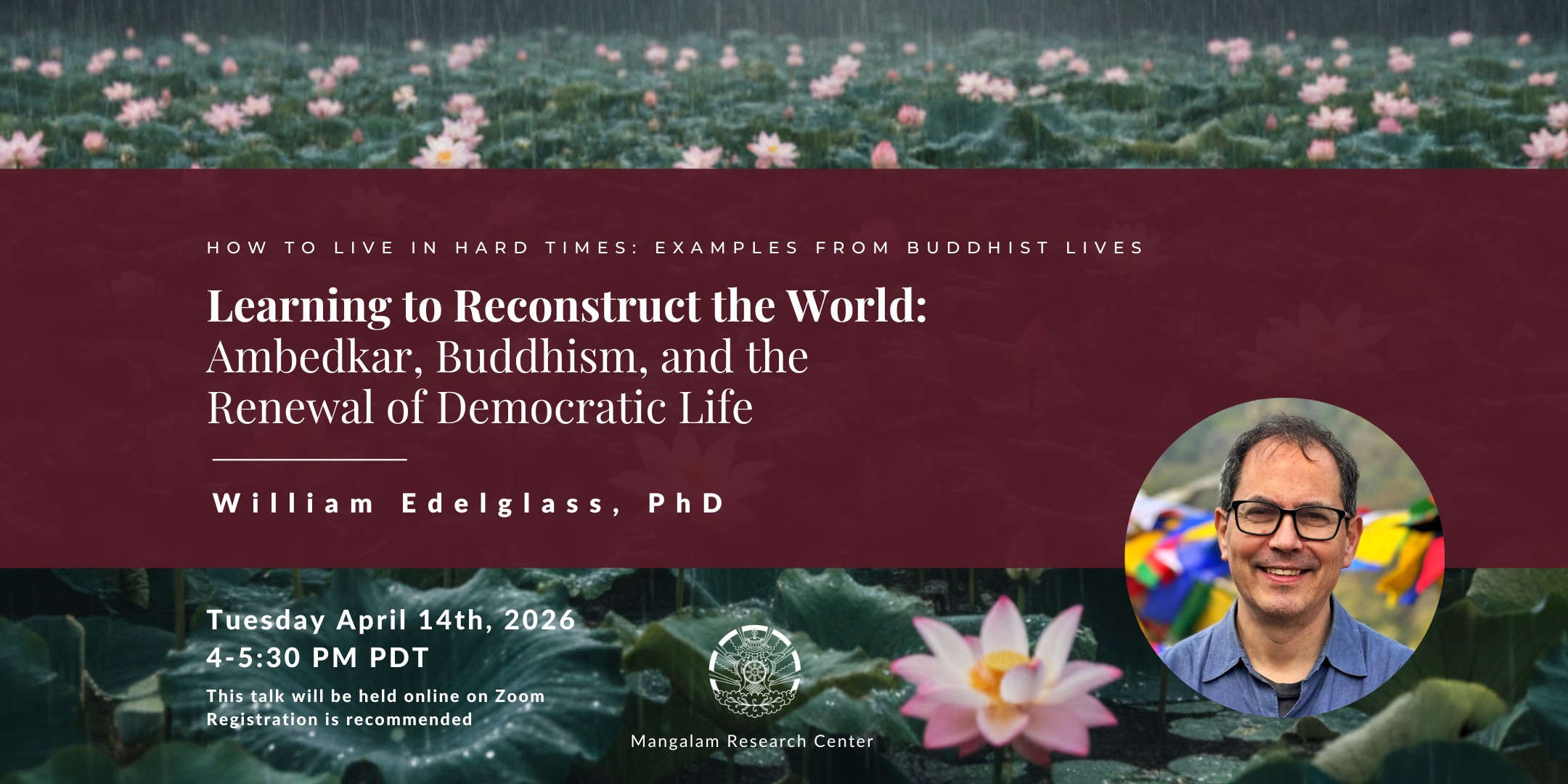
Learning to Reconstruct the World:
Ambedkar, Buddhism, and the Renewal of Democratic Life
Tuesday, April 14, 2026 (4-5:30 pm PT) on Zoom
At a time when democratic norms and values are weakening, what might Buddhist practice offer to the renewal of democratic life? This talk explores the life and thought of Dr. B. R. Ambedkar — the principal architect of India’s Constitution — who launched a revolutionary Buddhist movement dedicated to justice, dignity, and equality.
The fourteenth child born into an “untouchable” family, Ambedkar was educated at both Columbia University and the London School of Economics and became a prodigious scholar whose work spanned economics, sociology, history, religious studies, and constitutional law. At the same time, he emerged as the most significant leader of marginalized communities in modern India, leading movements, building institutions, and organizing projects aimed at securing social justice and political rights.
Yet Ambedkar came to believe that legal and political reform alone were insufficient. He turned to Buddhism as the moral and cultural foundation for a more egalitarian democracy — one grounded in freedom, equality, and maitri. Ambedkar, and millions of Ambedkarite Buddhists today, envision a Buddhist practice that is not a retreat from the world but a project of “reconstructing the world” — a collective liberation from the violence of hierarchy and systemic oppression.
William Edelglass is Director of Studies at the Barre Center for Buddhist Studies. His writing and teaching engage Buddhist Studies, environmental humanities, and philosophy.
Upcoming Event
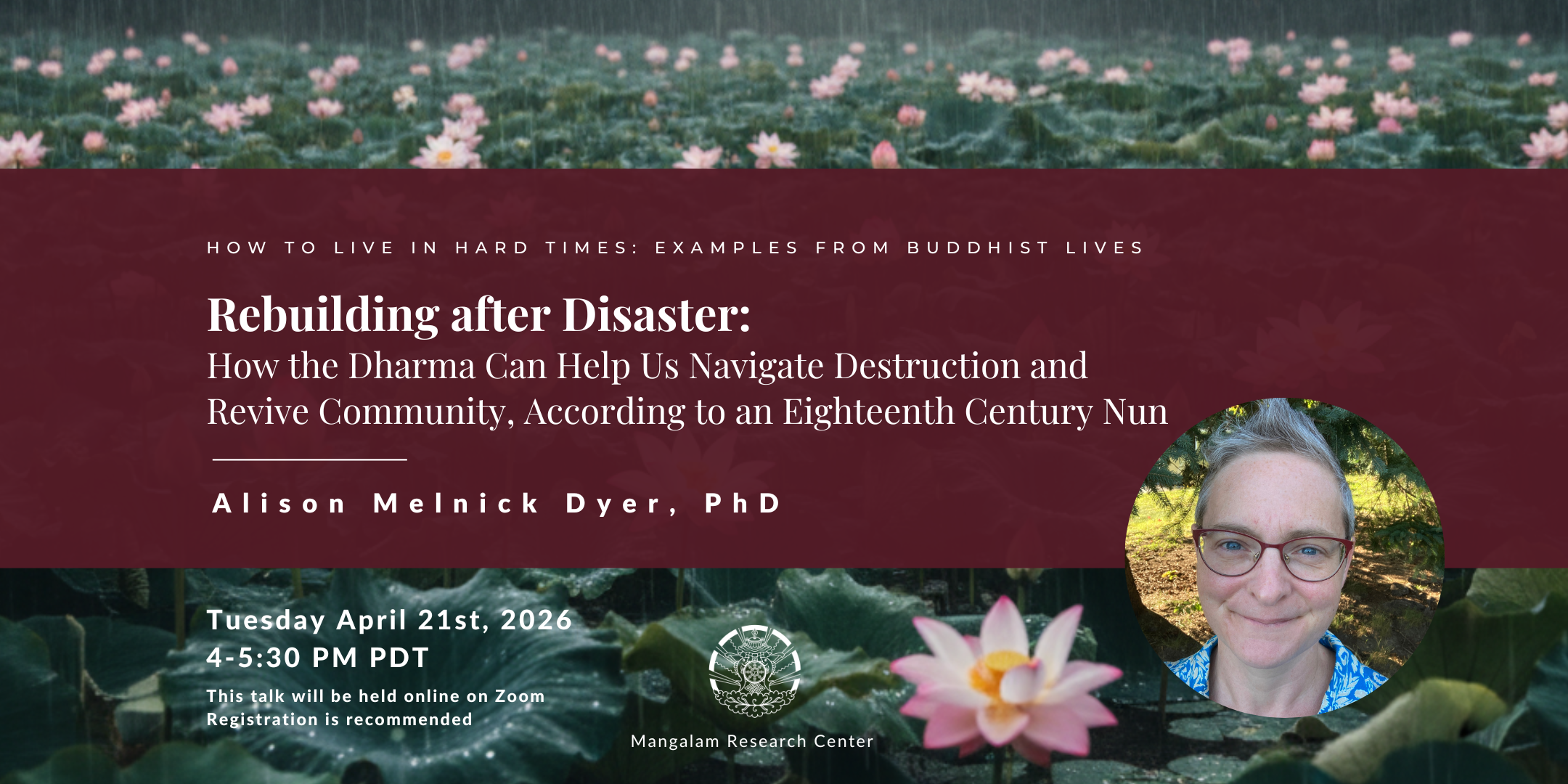
Rebuilding after Disaster: How the Dharma Can Help Us Navigate Destruction and Revive Community, According to an Eighteenth Century Nun
Alison Melnick Dyer, PhD
Tuesday, April 21, 2026 (4-5:30 pm PT) on Zoom
Despite being born into a comfortable household complete with the best religious education and a supportive family, Jetsün Mingyur Peldrön (1699-1769) was not protected from traumatic events. But from the time she was forced into exile when disaster struck her home in early adulthood, and through the various challenges of post-war reconstruction, she drew on Buddhist teachings to navigate hardship. Her life story offers many examples for how to rely on the dharma amidst all kinds of difficulty – from civil war to social bias – and how to thrive in the darkest of moments. In this talk we will explore how she moved through traumatic events, helped rebuild her community after it suffered almost complete devastation, and how she worked tirelessly to improve the lives of the nuns she supported. We will also think through what her approach to the various trials of 18th century Tibetan life – from single-pointed focus on contemplative practices, to the benefits of laughing in the face of danger – can teach us today.
Alison Melnick Dyer is an Associate Professor of Religious Studies and the Chair of the Asian Studies Program at Bates College. She is the author of The Tibetan Nun Mingyur Peldrön: A Woman of Power and Privilege (University of Washington Press, 2022). Her current work attends to gender dynamics and education in modern monastic communities, and the history of the Drikung Kagyu protector deity Achi Chökyi Drolma.
Upcoming Event
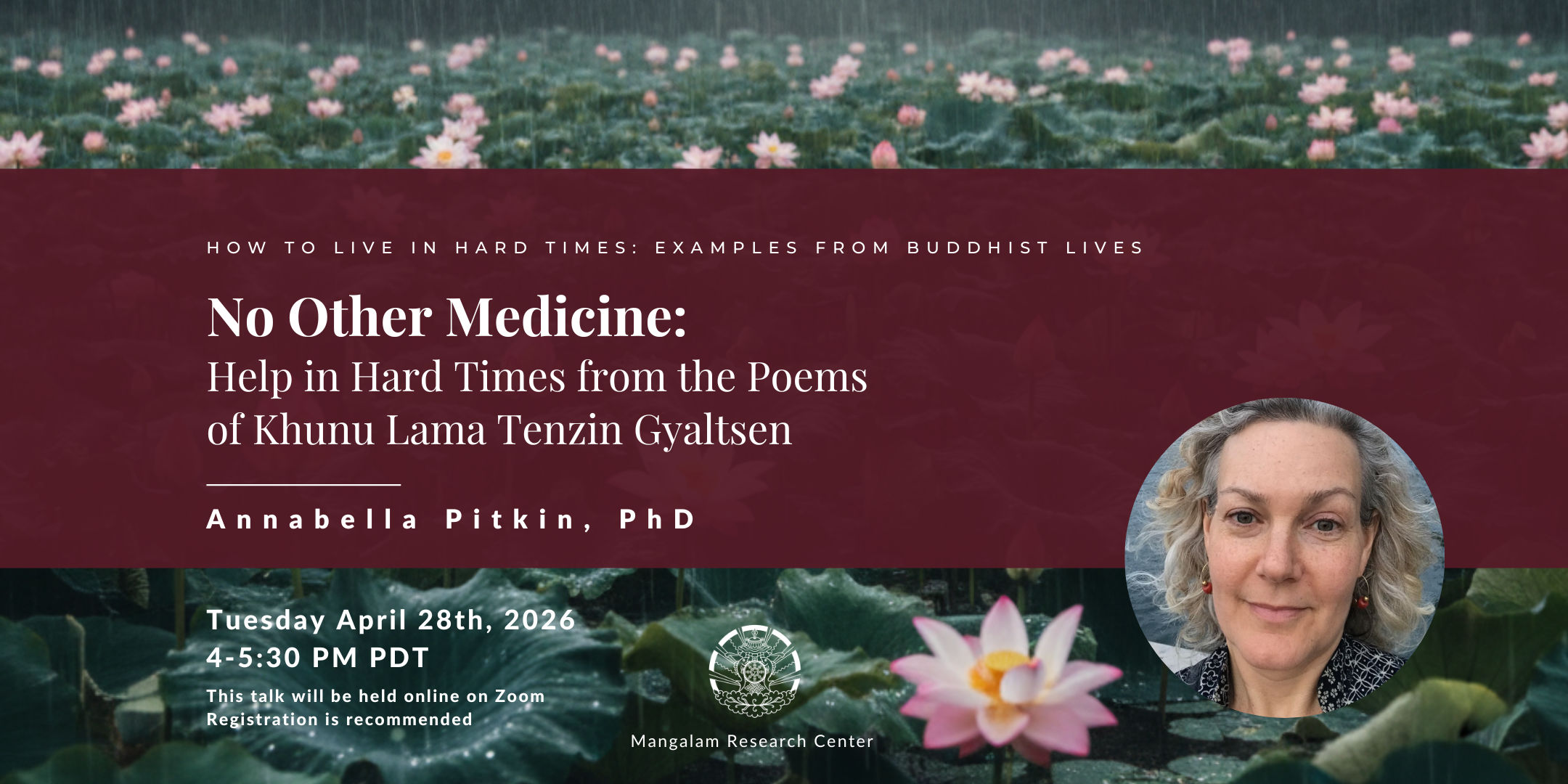
“No Other Medicine:” Help in Hard Times from the Poems of Khunu Lama Tenzin Gyaltsen
Annabella Pitkin, PhD
Tuesday, April 28 4-5:30 pm PT
How can we transform hard times into a practice of spiritual generosity? The Himalayan Buddhist renunciant Khunu Lama Tenzin Gyaltsen (1895–1977) wrestles with this question in his poems about bodhicitta, the wish to become enlightened for the benefit of others. Khunu Lama was a meditator, Buddhist teacher, and scholar, who embraced a life of voluntary poverty and simplicity. His poems are cherished by influential Tibetan Buddhist teachers today, including the 14th Dalai Lama. Khunu Lama composed his bodhicitta poems in 1959, as the Dalai Lama and thousands of other Tibetans were fleeing Chinese troops and becoming refugees in India. The poems never directly name those events. Yet Khunu Lama’s poems evoke the sorrow and fear of those times, together with the ordinary hardships of a life of renunciation. Throughout the poems, Khunu Lama reveals how he practices with difficulty, loss, and grief, by drawing on what he calls “the only medicine:” love, compassion, and bodhicitta. In responding to hard times, Khunu Lama’s poems also – maybe surprisingly – turn toward delight. They remind us of beauty in the natural world, human creativity, and poetry itself.
Annabella Pitkin is a scholar of Tibetan Buddhist intellectual history, philosophy, and literature, and associate professor of Buddhism and East Asian religions at Lehigh University. Her work explores themes of renunciation, power, and the bodhisattva ideal. She is the author of Renunciation and Longing: The Life of a Twentieth-Century Himalayan Buddhist Saint (2022), which engages themes of relationship, loss, and memory in the life of the meditator-poet Khunu Lama Tenzin Gyaltsen (1895-1977). Her current research focuses on Buddhist approaches to anti-authoritarian politics.
Past Event
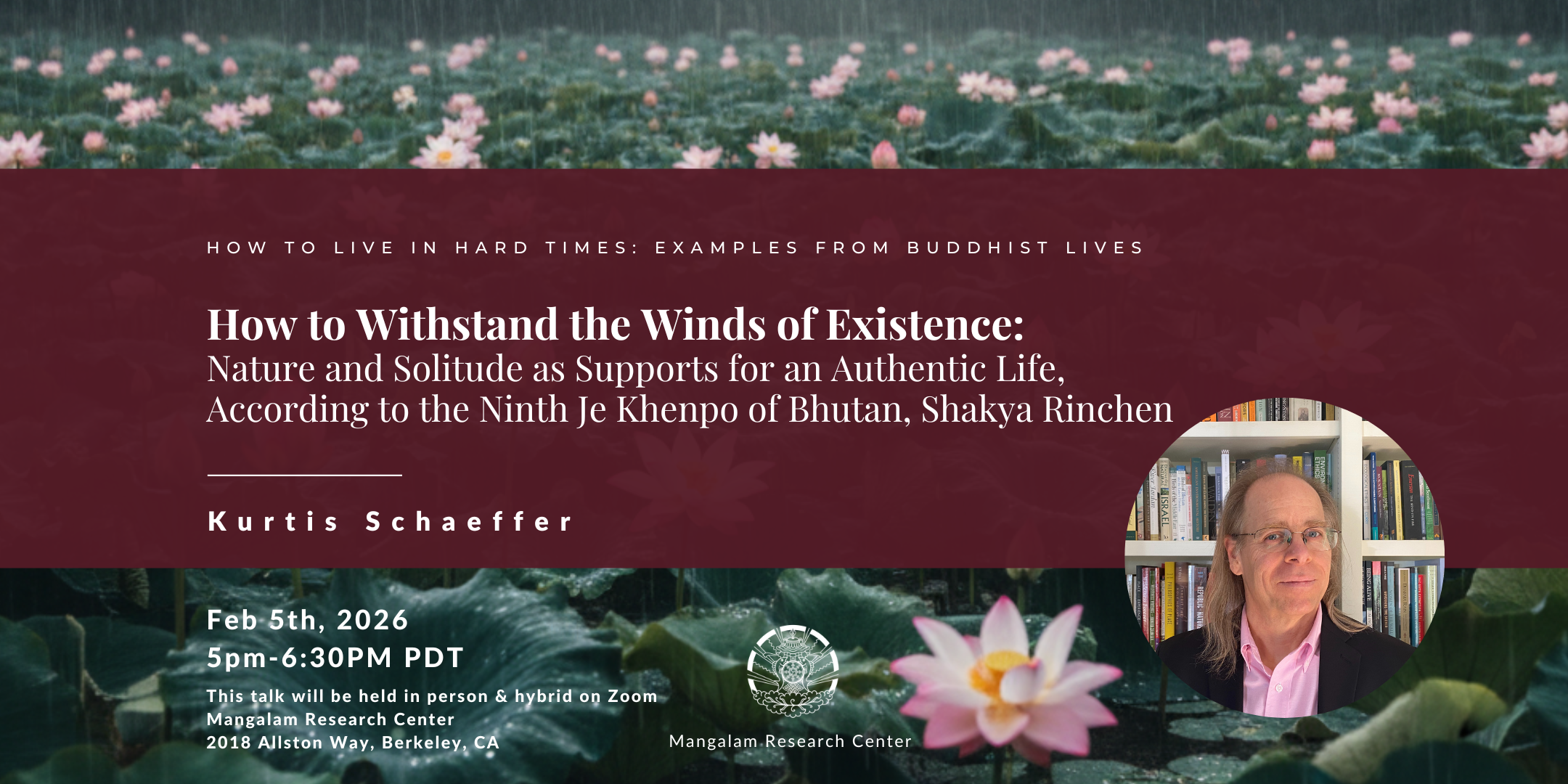
How to Withstand the Winds of Existence: Nature and Solitude as Supports for an Authentic Life, According to the Ninth Je Khenpo of Bhutan, Shakya Rinchen
Feb 5th (5-6:30 pm PT)
The Ninth Je Khenpo, Shakya Rinchen (1710-1759) is one of the most important writers in the history of Bhutanese Buddhist literature. His large anthology of occasional writings, “The Fresh Lotus Garland: A Disorganized Collection of Tales Recalling the Buddha to Amuse and Encourage Myself in Solitude” is among his most creative works. In this talk we will read a brief excerpt of Shakya Rinchen’s writing on seclusion, samsara, and environment, and reflect on his thoughts about the capacity of natural solitude to aid us in living a more authentic life, one that is not subject to the infamous eight mundane obsessions—gain and loss, pleasure and pain, fame and irrelevance, praise and blame.
Kurtis Schaeffer is a student of Buddhist literature in Tibet and the Himalayas. He is the translator of The Life of the Buddha (2014) and Buddhist Meditation: Classic Teachings from Tibet (2024), both from Penguin Classics, and the author of Himalayan Hermitess (2004), The Culture of the Book in Tibet (2009), and other books. He is the Frances Myers Ball Professor in the Department of Religious Studies at the University of Virginia.
Past event
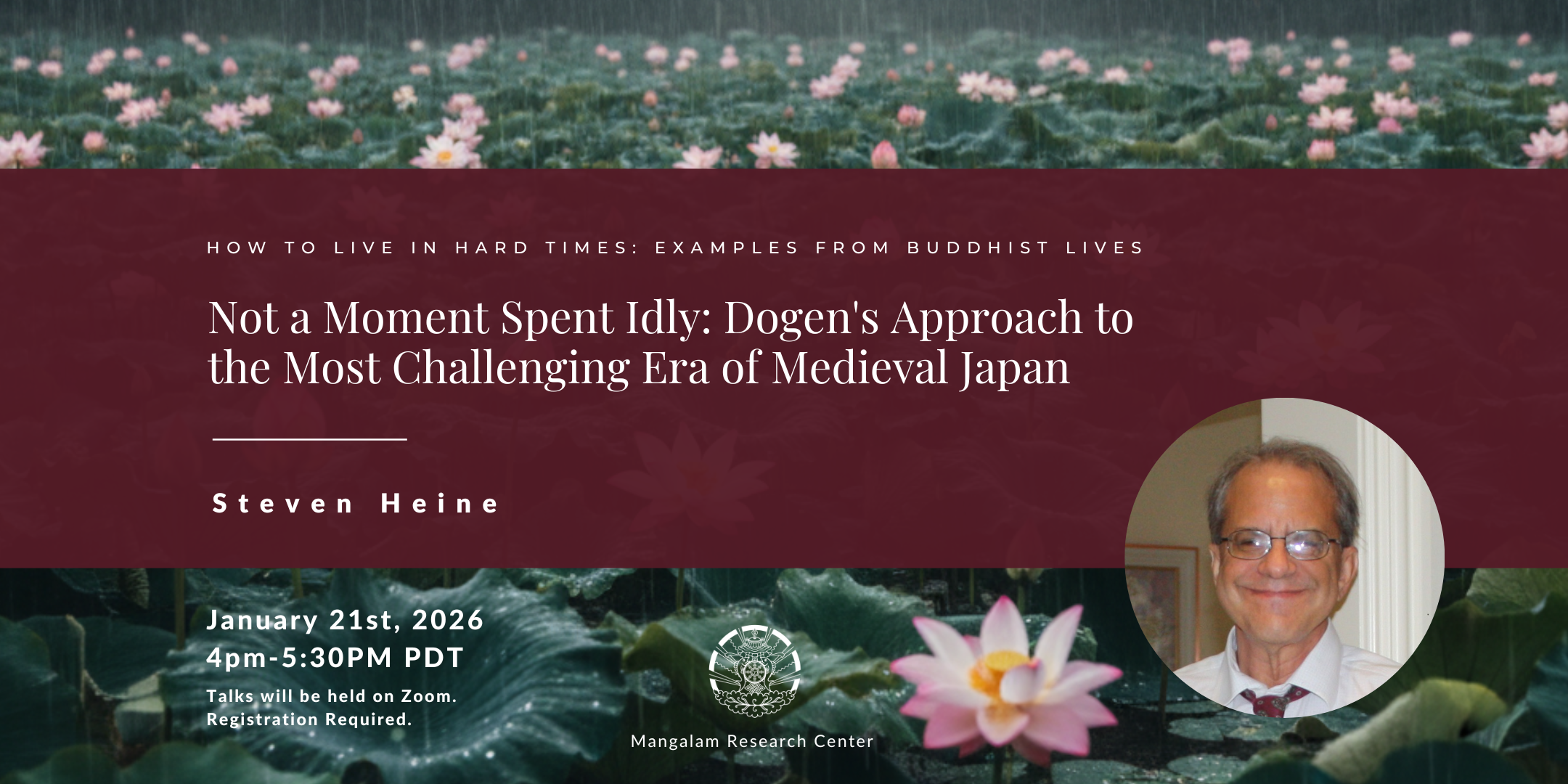
Not a Moment Spent Idly: Dogen's Approach to the Most Challenging Era of Medieval Japan
January 21, 2026 (4-5:30 PT)
Zen master Dōgen (1200-1253), founder of the Soto sect in thirteenth century Japan, was born into turbulent times and continually encountered challenges on personal, political, and philosophical levels throughout his lifetime. Medieval Japan was wracked by constant civil warfare and social instability in addition to a series of natural disasters that wreaked havoc on the capital city of Kyoto. According to a famous epic narrative from this period, “Human pride doesn’t stand for long, like a passing dream on a night in spring. Even the bravest are in the end brought down, no more than dust cast about by the wind.” Dogen himself was orphaned as a young child and came into conflict with the leading priests when he questioned orthodox doctrine at age fourteen. He became skeptical of corruption in the temple halls of China and Japan and was forced to flee Kyoto by rival sects before turning down offers from government leaders to lead a new monastery or to receive the prestigious purple robe.
His outlook was based on a resilient commitment to persevering each and every moment of existence through carrying out a diligent dedication to the principles of dignity and integrity. Near the end of his life, he wrote a poem titled, “Not a Moment Spent Idly in Twenty-Four Hours”: “Over forty years have so quickly passed! / Day and night, I followed / The path of the sun and moon, / Which, like the hare and crow, / Travel swiftly in the sky.” This talk will examine what Dogen meant by referring to non-idleness, or a sustained approach to self-exertion (gyōji), and how this practice method functioned for him in the face of personal and political upheaval.
Steven Heine is professor and founding director of the Asian Studies Program at Florida International University. A recipient of the Order of the Rising Sun Award for a lifetime of service to the dissemination of Japanese culture in the west, Heine has published forty books on East Asian religion and society, particularly dealing with the origins of Zen Buddhism in China and the impact on Dogen’s life and thought, as well as the transmission of the Soto sect to Japan. Some of the titles include The Zen Poetry of Dogen, Did Dogen Go to China?, Dogen: Textual and Historical Studies, Readings of Dogen’s Treasury of the True Dharma Eye, and Dogen: Japan’s Original Zen Teacher
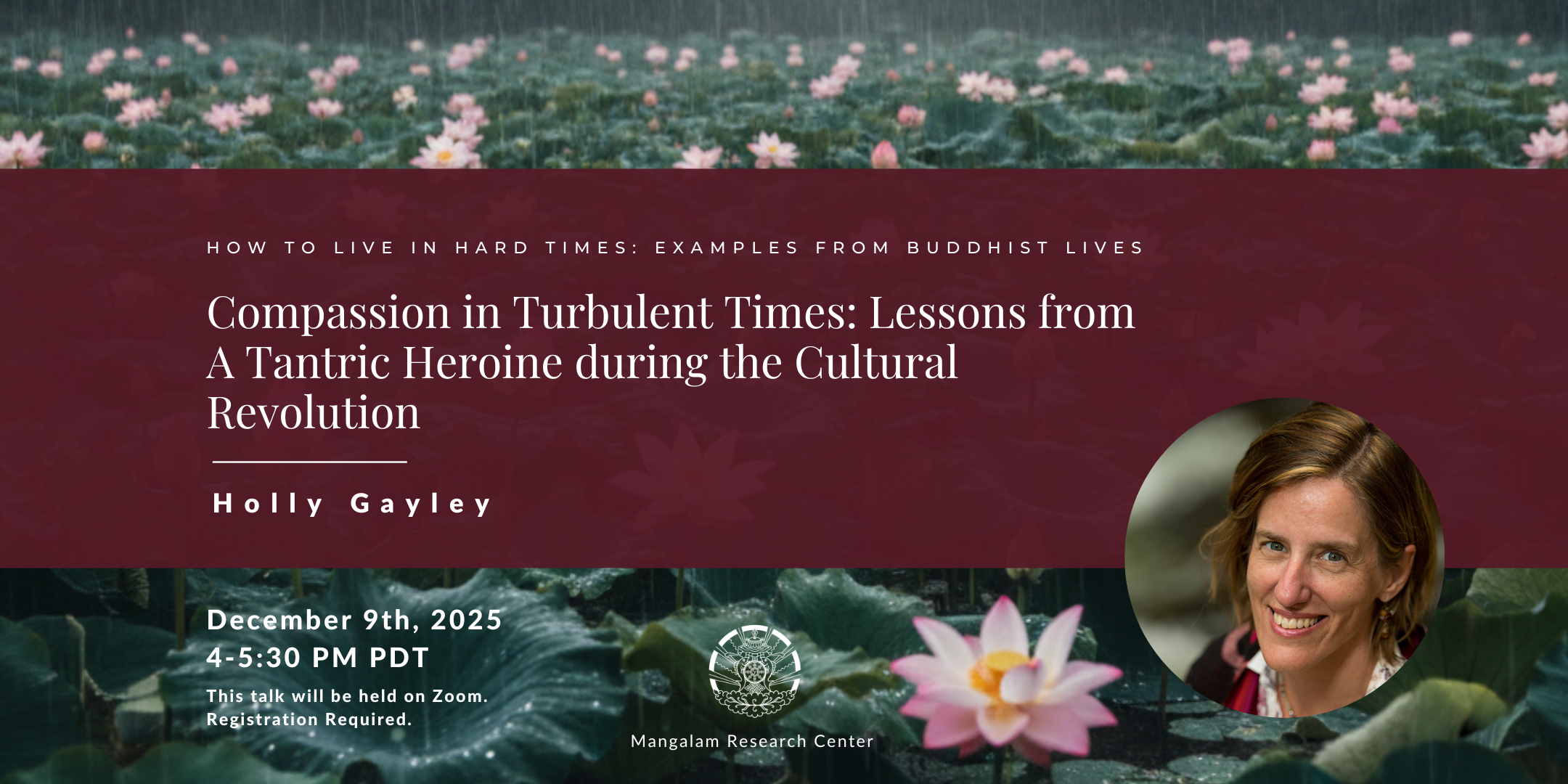
Compassion in Turbulent Times: Lessons from A Tantric Heroine during the Cultural Revolution,
Dec 9, 2025 (4-5:30 PT)
The lives of Buddhist masters offer inspiration and solace not just for practice but also for dealing with challenges during times of upheaval. Stories of survival through the Cultural Revolution for Tibetans under Chinese colonial rule are especially potent. As one example, Khandro Tare Lhamo served as a beacon of hope for her local community in the nomadic region of Golok (eastern Tibet) during the horrors of widespread famine, cultural destruction, imprisonment of secular and religious leaders, political reeducation, and more. Unlike “scar literature” of the post-Mao era, her life story presents a redemptive narrative with a tantric heroine at the fore. In several tales, she remains “unscarred” in struggle sessions and rescues others from calamities by maintaining compassion at the forefront of her mind. Thereafter, Khandro Tare Lhamo was one of a circle of surviving Nyingma masters to “heal the damage of degenerate times” during the post-Mao era and revitalize Buddhist practices, teachings, and institutions in the region of Golok. Her story can help inspire our own courage and compassion during the political turbulence of our times in order to be of service and heal collective trauma.
Holly Gayley is a scholar and translator of Buddhist literature in contemporary Tibet and associate professor at the University of Colorado Boulder. Her research explores gender and sexuality in Buddhist tantra, literature by and about Tibetan and Himalayan women, ethical reform in contemporary Tibet, and theorizing translation, both literary and cultural, in the transmission of Buddhist teachings to North America. She is author of Love Letters from Golok: A Tantric Couple in Modern Tibet (2016) and editor of Voices from Larung Gar: Shaping Tibetan Buddhism for the Twenty-First Century (2021).